
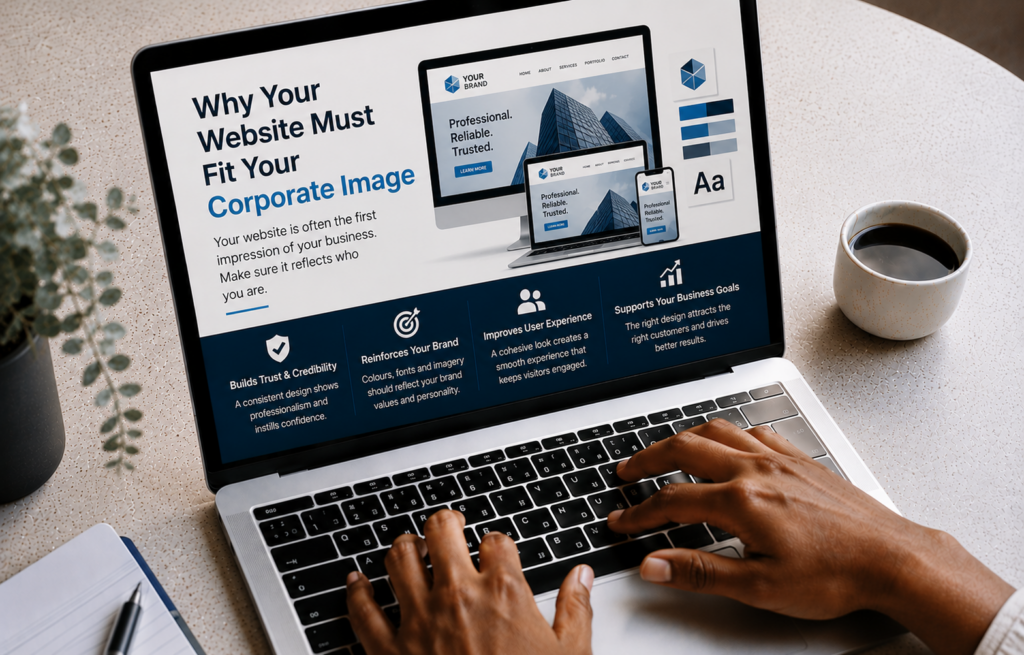
Your website is often the first place potential customers interact with your business.
They may discover you through Google, follow a link from social media or type your web address directly. Either way, they start forming an opinion about your company almost immediately.
Therefore, your website shouldn’t feel separate from the rest of your business.
Your logo, colours, typography, photography, tone of voice and overall website design should reflect your corporate image. When these elements work together, customers experience one consistent brand.
However, when your website and corporate identity don’t match, the result can feel confusing, outdated or unprofessional.
What Is Your Corporate Image?
Your corporate image is the overall impression people have of your business.
Your logo forms part of it, but your corporate identity extends much further.
It includes elements such as:
- Your logo
- Corporate colours
- Typography
- Photography
- Graphic style
- Marketing material
- Signage
- Packaging
- Social media
- Tone of voice
- Customer experience
Together, these elements communicate who you are and what customers can expect from your business.
Your website should therefore feel like a natural extension of that identity.
Your Website Is Part of Your Brand
Some businesses treat their website as a separate marketing tool.
They develop a professional logo, establish corporate colours and create attractive printed material. Then, when the website gets built, it follows a completely different visual direction.
That creates a disconnect.
Imagine receiving an elegant black-and-gold business card from a premium company and then visiting a website filled with bright colours, playful fonts and cartoon graphics.
The individual website might look perfectly good.
However, it doesn’t feel like the same company.
Therefore, good website design shouldn’t simply ask:
“Does this website look attractive?”
It should also ask:
“Does this website look like this business?”
Consistency Builds Brand Recognition
Think about successful brands you immediately recognise.
You often don’t need to see their company name. Colours, typography, photography or other visual elements are enough to identify them.
That recognition develops through consistency.
Your website provides another opportunity to reinforce those same visual signals.
Therefore, use your established corporate colours consistently. Likewise, maintain appropriate typography, image styles and graphic elements throughout the website.
The goal isn’t to cover every page with your logo.
Instead, your visitors should gradually become familiar with your visual identity simply by using the website.
Your Website Creates an Important First Impression
Potential customers may see your website before they see your office, vehicle, signage or printed marketing material.
Therefore, the website could be responsible for their first meaningful impression of your company.
That impression matters.
Research from Nielsen Norman Group has long shown that visual design and content can influence perceptions of an organisation’s credibility. (Nielsen Norman Group)
Consequently, an outdated or poorly designed website can affect how visitors perceive an otherwise professional business.
If your corporate image says modern, established and professional, your website should communicate the same message.
Design Helps Communicate Your Position in the Market
Different businesses need different website personalities.
A corporate law firm shouldn’t necessarily look like a surf shop.
Likewise, a children’s entertainment company probably shouldn’t look like a financial services provider.
Your website design should support how you position your business.
For example, a premium brand may benefit from:
- Generous white space
- Refined typography
- High-quality photography
- Restrained colour use
- Simple navigation
- Carefully written content
Meanwhile, a youthful creative business may use stronger colours, energetic typography and more playful imagery.
Neither approach is automatically better.
The correct approach is the one that fits the brand and its customers.
Your Tone of Voice Is Part of Your Corporate Image
Corporate identity isn’t purely visual.
The words on your website matter too.
A business that communicates casually everywhere else shouldn’t suddenly sound like a legal contract online.
Likewise, a highly professional corporate organisation may need a more formal and authoritative tone.
Nielsen Norman Group research found that different website tones can measurably affect how users perceive characteristics such as friendliness, trustworthiness and desirability. (Nielsen Norman Group)
Therefore, your website copy and visual design should work together.
If your company personality is friendly and approachable, let the content sound friendly and approachable.
If you’re technical and authoritative, communicate expertise without making the content unnecessarily difficult to understand.
Your Photography Needs to Match the Brand
Images can completely change the personality of a website.
Unfortunately, this is where many otherwise professional websites lose consistency.
Generic stock photographs may technically relate to the service, but they might have nothing to do with the personality of the company.
Instead, establish a clear photographic direction.
Consider factors such as:
- Lighting
- Backgrounds
- Clothing
- Locations
- Composition
- Colour
- Subject matter
- Image treatment
Where possible, use original photography of your team, products, premises or completed work.
However, high-quality stock or AI-generated imagery can also work when it’s carefully selected or created to match your brand.
The important thing is consistency.
Your Website Should Match Your Offline Marketing
Imagine someone receives your brochure at an exhibition.
Later, they visit your website.
Do the two experiences feel connected?
They should.
The same principle applies to:
Business cards → Website
Signage → Website
Vehicle branding → Website
Packaging → Website
Social media → Website
Email signatures → Website
Your customer moves between these different touchpoints.
Therefore, maintaining a recognisable corporate image makes that journey feel more coherent.
Corporate Consistency Doesn’t Mean Every Page Must Look the Same
Brand consistency shouldn’t make your website boring.
You can still introduce different layouts, photography and visual elements across pages.
The key is maintaining a common design language.
For example, your service pages might use different hero images. However, they can still use the same typography, button styles and corporate colour palette.
Likewise, blog articles can have unique featured images while retaining a consistent visual treatment.
The pages don’t need to be identical.
They simply need to look like they belong to the same website and the same company.
Good Branding Can Improve Website Usability
Consistency isn’t only about appearance.
It can also make websites easier to use.
When buttons, navigation elements, headings and other components behave consistently, visitors learn how your website works.
They don’t need to reinterpret the interface on every page.
Clear navigation and consistent standards remain established usability principles. (Nielsen Norman Group)
Therefore, your website’s design system should define more than colours and logos.
It should also create consistency in how visitors interact with the website.
Your Website Design Should Support SEO
Matching your corporate image doesn’t directly make Google rank your website higher.
However, good website design and good SEO shouldn’t work against each other.
Google recommends creating a strong overall page experience. That includes mobile usability, Core Web Vitals, security and making the main content easy for visitors to identify. (Google for Developers)
Therefore, don’t sacrifice performance or usability simply to create an elaborate branded experience.
The best approach combines:
Brand + User Experience + Content + Performance + SEO
A beautiful website that nobody can find isn’t particularly useful.
Likewise, a website ranking well on Google may still waste opportunities if visitors arrive and don’t trust what they see.
Your Website Content Should Reflect Your Expertise
Your corporate image also includes what your business knows.
Therefore, your website should demonstrate genuine expertise rather than simply making broad claims about being “the best.”
Explain your services properly.
Answer customer questions.
Show completed work where appropriate.
Publish useful articles.
Most importantly, create content that genuinely helps potential customers understand your business.
This approach also aligns with Google’s recommendation to create helpful, reliable, people-first content that demonstrates experience and expertise. (Google for Developers)
Don’t Let a Template Define Your Brand
WordPress provides thousands of themes and templates.
They’re useful starting points.
However, a template should adapt to your brand rather than forcing your brand to adapt to the template.
If you simply replace a demonstration logo and photographs while leaving everything else unchanged, your website can still look generic.
Therefore, customise the design around your corporate identity.
Use your colours intelligently. Choose typography appropriate to your business. Develop layouts that suit your content and select imagery that supports your visual direction.
The finished website should look like your website, not a modified demo.
What If Your Existing Corporate Identity Is Outdated?
Sometimes the problem isn’t the website.
The corporate identity itself may need attention.
Perhaps your logo was created 15 years ago and no longer reflects the business. Maybe your company has grown significantly, changed markets or introduced completely different services.
In that case, redesigning your website around an outdated identity could be a missed opportunity.
Instead, consider whether the branding needs refreshing first.
That doesn’t necessarily mean throwing everything away.
You might retain recognisable elements while refining your:
- Logo
- Colour palette
- Typography
- Graphic style
- Photography
- Brand guidelines
Then, the new website can introduce the refreshed corporate identity consistently.
Logo Design and Website Design Work Better Together
If you’re starting a new business, developing the logo and website together can be extremely effective.
The website designer already understands how the logo will need to function digitally.
For example, a logo needs to work in a website header without becoming unreadable.
It may also need different versions for dark and light backgrounds.
Likewise, the designer can develop a colour palette and typography system that works across both branding and website design.
As a result, the finished identity feels considerably more cohesive.
When Should You Review Your Website’s Corporate Image?
You don’t need to redesign your website every time your business cards change.
However, it’s worth reviewing your online brand periodically.
Ask yourself:
Does the website still look like our business?
Are we using our current logo and colours?
Does the photography represent us accurately?
Does the writing sound like us?
Does the website reflect our current customers?
Does it represent the quality of our products or services?
Would someone recognise our brand without seeing the logo?
If several answers are no, it may be time to revisit the design.
Don’t Follow Trends at the Expense of Your Brand
Website design trends change constantly.
One year everyone uses enormous typography. The next year gradients return. Then animation becomes popular.
There’s nothing wrong with incorporating current design ideas.
However, trends should support your brand rather than define it.
A website can feel contemporary without looking like every other website launched that year.
Therefore, start with your corporate identity and customer needs.
Then use current design techniques where they improve the experience.
Your Website Should Look Like Your Business — At Its Best
Your website doesn’t need to recreate your office or brochure pixel for pixel.
Instead, it should represent the best digital expression of your brand.
Someone who knows your business should immediately recognise it.
Meanwhile, someone discovering you for the first time should quickly understand the type of company they’re dealing with.
That’s when website design and corporate identity are working together effectively.
Need a Website That Fits Your Brand?
Your website shouldn’t feel like something separate from your business.
It should bring your corporate identity, services, personality and marketing message together in one professional digital experience.
The Digital Nomad provides website design, logo design and graphic design in Ballito, helping businesses create a consistent presence both online and offline.
We also work with businesses across Umhlanga, Durban and South Africa, combining WordPress website design, branding and SEO to create websites built around the businesses they represent.
Does your website still look like your business? Talk to The Digital Nomad about creating a website that looks, feels and communicates like your brand.